AI often starts with something small. Someone uses it to draft an email, summarise a meeting or prepare a document. It saves time, so they start asking what else it could do.
Soon, personal productivity leads to a bigger question: can AI help us find and use what our business already knows?
Policies, procedures, customer history and the experience of other teams become more useful when people can access them at the right moment. Then the questions become more ambitious. Which customers are becoming less profitable? Where are we losing time? What should we do differently?
Answering those questions takes more than access to an AI tool. It requires reliable information from across the business, with the right context and permissions.
In his CEO Institute presentation, Closing the Tech ROI Gap, Ross Sardi identifies six ways businesses can use AI: personal productivity, knowledge and interaction, intelligent automation, intelligent analytics, AI-assisted development and agentic workflows.
These uses can overlap. They are not a fixed sequence every organisation must follow. But as businesses explore more of them, they often need access to more connected information.
Customer records might sit in a CRM, transactions in a finance platform, operational information in an ERP, and policies and contracts in SharePoint.
One team connects an AI assistant to its documents. Another connects a finance system. A third needs information from both. Each new use case adds another connection and another set of decisions about what information it should use and who should be able to see it.

A direct connection can be a sensible way to test an idea. The difficulty comes when separate connections become the way the whole business operates.
Someone has to administer them, keep them working and check access whenever something changes. A new employee joins. Someone changes roles. An API changes. A connection breaks. When every tool has its own settings, the same work can be repeated across several platforms.
Permissions can create problems in both directions. People may be blocked from information they need, while others gain access to information they should not see.
In his recorded conversation with Brendan Ritchie, Ross uses a finance system to illustrate the distinction. An account manager might need to check whether a customer has paid. Another person needs the profit and loss statement. Someone else works with payroll. Access to the same system should not give all three people the same view.
The information also needs to be trustworthy. An old policy can sit beside the current version. The same customer can appear differently in two systems. Departments may use different definitions of revenue. Without resolving those differences, an AI tool can produce a convincing answer based on the wrong information.
Cross-system questions add another challenge. If each profitability query requires a tool to find, reconcile and interpret the same records again, the business keeps solving the same problem. Repeated queries can also put pressure on operational systems and their API limits.
The aim is to make information more useful without creating another layer of administration for every new idea.

CORE Intelligence is a managed data intelligence platform that brings relevant business data together, prepares it for use and applies context, governance and permissions. It provides a foundation for AI, analytics and automation, with ongoing support for the underlying connections and data views.

Start with the systems needed for the business question or workflow. Bringing relevant information into a central platform allows it to be used without sending every query back through every source system. It also creates a shared place to connect information that previously sat apart.
Moving data is only the first step. Information needs to be checked for outdated or incorrect content, and related records need to be linked. A customer appearing in the CRM and finance system should be recognised as the same customer where the records support that relationship.
Business definitions matter too. What counts as revenue? Which period are you comparing? Which customer group is relevant? Those definitions need to be established rather than left for a model to guess.
The governance layer addresses where information comes from, who accesses it and who should be able to retrieve it. Managing those controls centrally helps distinguish an account manager checking customer payments from someone authorised to see payroll data.
The platform needs attention after implementation. Connections, fields and business requirements change. Ongoing monitoring, maintenance and support help keep the underlying environment useful as those needs evolve.
Together, these capabilities can support dashboards, natural-language questions and automated workflows. Each application still needs an agreed purpose and implementation scope. The platform does not automatically deliver every dashboard, assistant or automation a business might want.
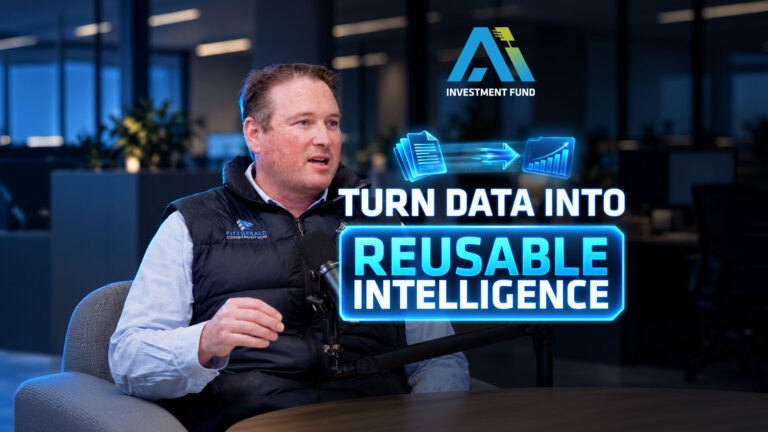
In the interview, Ross describes a financial services customer whose technology team already understood the need to bring its data together. The proposed build had an expected return. However, its upfront cost and the time needed to realise that return made it difficult for the board to approve.
CORE Intelligence offered a smaller starting commitment and a way to test the approach incrementally: begin with one data source, add another and expand as the business learns what is useful.
The point is not to connect everything at once. It is to establish whether a focused use case can deliver enough value to justify the next step.
Better access to data is useful only if it changes what people can do.
If a report identifies falling margins in a customer segment, who investigates? If a workflow removes manual processing, how will the business measure the time released? If an insight suggests a different approach to customer retention, who can act on it?
A practical starting point includes:
That measure might be time spent preparing an answer, processing effort, margin, retention or another outcome that matters to the organisation.
It also provides a basis for evaluating the investment. Ross describes a setup cost, a base platform fee covering support and maintenance, and monthly fees that vary with the complexity of the connected data sources. The question is which initial scope can demonstrate value before the business commits to more.
Watch the conversation
Winning more construction tenders with better data and AI
If an important decision is waiting on disconnected systems, manual reporting or information people cannot confidently use, that is a useful place to start. Identify the outcome, connect the information it requires and test whether the new capability improves the way your team works.
Talk to First Focus about how CORE Intelligence could support that first business case and provide a foundation for what comes next.

 IT Consulting
 IT Strategy
 Data Services
 IT Infrastructure Projects
 IT Procurement
 Virtual CIO
 Offshore Staff Outsourcing (BPO)
 Managed AI & IT Services
 IT Support Services
 Managed Cloud Services
 Managed SharePoint Services
 End User Computing
 Unified Communications
 Connectivity
 Managed Security Services
 Cybersecurity Risk Assessment
 Business Continuity Planning
 Cloud Backup and Disaster Recovery

 Automation
 Digital Transformation
 Power BI
 Careers
 Awards and Certifications
 Management Team
 Case Studies
 Sell Your IT Business
 Our Commitment to the Environment
 CSAT Charity Donations
 Media Kit
 Auckland | Tāmaki Makaurau