Most small and medium-sized businesses do not lose productive time in one dramatic event. It disappears in small, repeated moments: waiting for a system to load, searching for a document, entering the same information twice or working around a process that does not work well.
Each moment may seem minor. Together, they create a hidden cost.
When people think about technology problems, they often think about outages, security incidents or hardware failures. These problems are visible and usually reported.
Friction is quieter. It might be an employee spending ten minutes looking for a customer file, a manager checking a report because the information does not match, or a salesperson copying details between systems.
These issues may not show up in service desk reports, but they still break concentration, delay decisions and make everyday work more costly.
For an SMB, the impact is amplified. The same people often manage customers, administration, reporting and delivery. When everyday tasks take longer than they should, the effect can be felt in customer service, quality, capacity and growth.
The useful question is not simply, “How much time are we losing?”
It is: what valuable work is being pushed aside?
Ten minutes spent searching is ten minutes not spent with a customer. Repeating a manual task is time not spent improving the business. Checking information that should already be clear is time not spent making a decision.
This is the hidden opportunity cost of IT friction. The cost is not only the time spent on the frustrating task. It is also the value of the work that could have been done instead.
Productivity creates capacity. Capacity only creates value when it is redirected into sales, service, speed, quality or margin.
Technology and AI can help people complete individual tasks faster. For example, it might help someone draft an email, find information or prepare a document.
That is useful, but saving time for one person does not automatically improve the business. If the saved time is simply filled with more low-value work, the business may become faster without becoming more effective.
The important question is what happens to the time that has been recovered.
Can the team respond to customers more quickly? Complete more work with the same people? Improve quality? Make better decisions? Support growth? Reduce risk?
A small First Focus LinkedIn poll asked businesses where they were currently using AI, with four options: personal productivity, finding information inside the business, AI-powered analytics and AI-powered automation. Most respondents selected personal productivity, while the remainder selected AI-powered automation.
The poll was a small sample, but it reflects a common starting point. People often begin by using technology to make their own work easier. The next step is connecting those time savings to a wider business outcome.
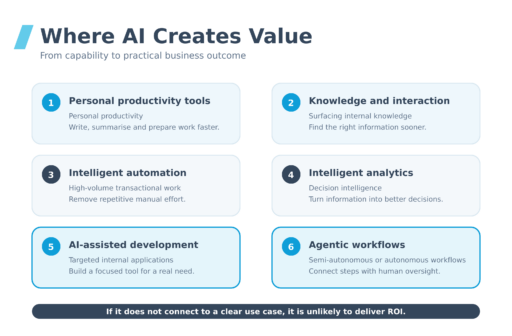
Recovered time only becomes useful capacity when people have the right support around them.
Information needs to be easy to find. Tools need to work together. People need appropriate access, clear processes and confidence that the information they are using is accurate and secure.
Without these basics, businesses can end up adding more tools without solving the original problem. Information becomes harder to find, people use different versions of the same document and each new system creates more processes to maintain.
This is why the answer is rarely just buying another software licence. Technology creates lasting value when it is connected to reliable information, clear processes, appropriate security and ongoing support.
That is the role of CORE. It brings managed IT, AI and automation enablement, data governance, security and modern workplace support together, so businesses can turn individual productivity gains into broader business capacity.
Start with one recurring source of friction. Before choosing a tool or changing a process, ask:

For most SMBs, a return within 12 months is ideal. Opportunities that take longer than 24 months carry more risk unless they are introduced in stages.
Measure how the work is done today. Improve the process where possible, then test the simplest solution that could remove the problem.
Look for evidence such as:
The result should help the business decide whether to continue, change direction or stop.
The hidden cost of IT friction is not just the minutes lost to slow systems, manual tasks or difficult processes. It is the valuable work those minutes displace.
The first question should not be, “What can this technology do?” It should be, “Where is work being slowed down, and what would improve if we removed that friction?”
The answer might be faster customer service, fewer mistakes, better decisions, more capacity or reduced risk. The important point is to connect the technology to an outcome the business can recognise and measure.
First Focus CORE helps businesses make that connection. It brings managed IT, AI and automation enablement, data governance, security and modern workplace support together, so technology is tied to practical business goals rather than treated as a collection of separate tools.
If you are ready to identify where technology could free up time and create more capacity in your business, talk to the First Focus team on 0800 136 287 or email sales@firstfocus.co.nz.

 IT Consulting
 IT Strategy
 Data Services
 IT Infrastructure Projects
 IT Procurement
 Virtual CIO
 Offshore Staff Outsourcing (BPO)
 Managed AI & IT Services
 IT Support Services
 Managed Cloud Services
 Managed SharePoint Services
 End User Computing
 Unified Communications
 Connectivity
 Managed Security Services
 Cybersecurity Risk Assessment
 Business Continuity Planning
 Cloud Backup and Disaster Recovery

 Automation
 Digital Transformation
 Power BI
 Careers
 Awards and Certifications
 Management Team
 Case Studies
 Sell Your IT Business
 Our Commitment to the Environment
 CSAT Charity Donations
 Media Kit
 Auckland | Tāmaki Makaurau